

Artificial intelligence is transforming engineering. Systems are designed faster, code is generated automatically, and prototypes can be produced in hours instead of months. Across industries, development cycles are compressing while system complexity continues to grow.
But acceleration creates a new challenge: understanding and control.
When systems are generated rapidly, whether by humans or AI, the limiting factor is no longer production capability. It is the ability to ensure that what has been built is correct, aligned with intent, and robust under all relevant conditions.
This is not only a safety issue. It is a systems engineering issue.
The real bottleneck: Clarity of intent
Many engineering failures do not originate in code. They originate in ambiguity:
- Requirements that are open to interpretation
- Assumptions that are not made explicit
- Incomplete descriptions of system behavior
AI amplifies this problem. It can generate implementations quickly, but it cannot resolve intent ambiguities. If the requirement is unclear, the generated result will faithfully encode that uncertainty.
The solution is not slower development. It is stronger specification.
Precise, structured, machine-verifiable specifications create a stable foundation for accelerated engineering. They turn intent into something analyzable, testable, and enforceable.
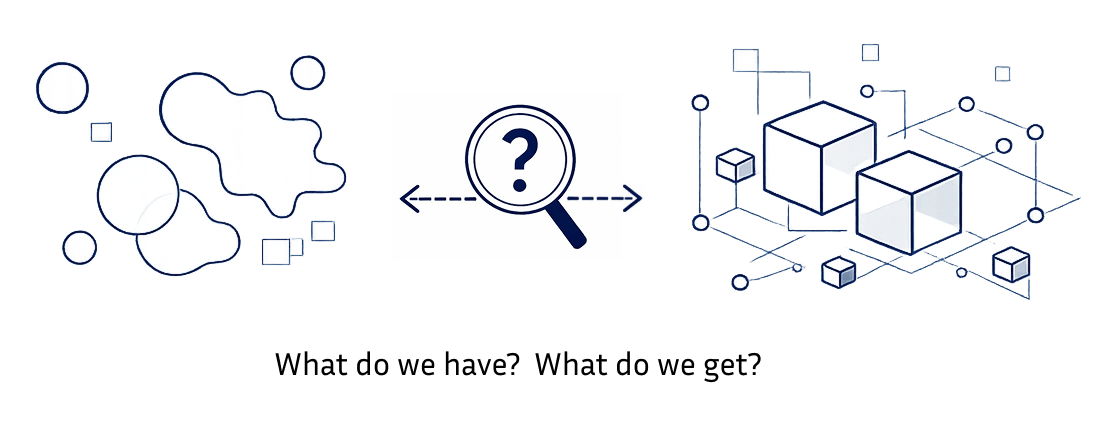
Executable models as a tool for understanding
One of the most powerful shifts in modern engineering is the transformation of specifications into executable models.
When specifications are expressed in a formal, structured way, they can be transformed into digital representations of system behavior, executable models that simulate how the system should act.
This fundamentally changes the early phases of development.
Instead of validating understanding through review alone, teams can:
- Execute scenarios against the intended behavior
- Detect inconsistencies before implementation
- Prototype system logic before committing to architecture
- Align stakeholders around observable behavior
Executable models are not merely simulation tools. They are instruments for shared understanding. They reduce ambiguity at the source.
Conformance and validation in an automated world
As automation increases, so must verification rigor.
Whether logic is handwritten, configured, or AI-generated, it must conform to the original intent. Formalized specifications allow automated conformance checking between:
- Requirements
- Design
- Implementations
This creates a closed loop in which generated artifacts can be systematically validated against defined behavior.
Verification and validation no longer depend solely on late-phase testing. They become continuous activities embedded in the development process.
The role of formal proof
Testing remains essential. But testing is inherently selective. It demonstrates that a system behaves correctly in tested scenarios, not that it behaves correctly in all scenarios.
Formal verification adds a fundamentally different dimension. Proving that defined properties always hold provides exhaustive logical coverage of the specified behavior.
This has two major effects:
- It reduces reliance on extensive test campaigns for certain defect classes.
- It strengthens the evidence base for safety, reliability, and correctness claims.
Formal proof does not replace engineering judgments. It augments it with mathematical certainty where it matters most.
In complex systems, particularly those developed with AI assistance, this level of rigor becomes a strategic advantage.
Engineering for both speed and confidence
The perceived tension between speed and rigor is a false dichotomy.
Strong specifications enable acceleration. Executable models enable early validation. Automated conformance checking maintains alignment. Formal proofs provide deep assurance. Together, they create a development process that is both faster and more controlled.
Prover’s methods support this paradigm by:
- Transforming specifications into executable system models
- Enabling early validation and prototyping
- Providing automated conformance checking
- Supporting formal verification to strengthen evidence and reduce excessive testing
The result is not only improved safety. It is improved understanding, improved predictability, and improved control over increasingly complex systems.
In the age of AI-driven engineering, the competitive edge will not belong to those who generate the most artifacts but to those who can demonstrate, with clarity and rigor, that their systems behave as intended.
Acceleration is inevitable. Assurance must be engineered.
Share this article
Learn to build a solid safety case for rail control systems using formal verification
Fill out your information here.
More News & Articles

Do you have experience in leading strategic and complex customer projects? Are you looking for an opportunity to leverage your experience throughout our company? Then this role might be right for you! We are now recruiting to a new position as a Commercial Project Management (PM) Lead.

Prover uses formal methods to make railway signaling provably safe. Our solutions build safe, reliable, and cost-efficient systems that move and protect millions of passengers every day. Through our Open Signaling Initiative, we're reshaping how the industry builds and maintains signaling systems across Europe and beyond. Now we're looking for someone to join us and bring AI, LLMs, and agentic workflows into the heart of how we work and what we build.
Meet Prover at RailTech Europe in Utrecht, March 4–5. Visit Booth 2.509 and join our workshop on migration of signaling systems to PLC-based SIL 4 solutions.


